About Me

My photo
Melfort, Saskatchewan, Canada
I am a lawyer in Melfort, Saskatchewan, Canada who enjoys reading, especially mysteries. Since 2000 I have been writing personal book reviews. This blog includes my reviews, information on and interviews with authors and descriptions of mystery bookstores I have visited. I strive to review all Saskatchewan mysteries. Other Canadian mysteries are listed under the Rest of Canada. As a lawyer I am always interested in legal mysteries. I have a separate page for legal mysteries. Occasionally my reviews of legal mysteries comment on the legal reality of the mystery. You can follow the progression of my favourite authors with up to 15 reviews. Each year I select my favourites in "Bill's Best of ----". As well as current reviews I am posting reviews from 2000 to 2011. Below my most recent couple of posts are the posts of Saskatchewan mysteries I have reviewed alphabetically by author. If you only want a sentence or two description of the book and my recommendation when deciding whether to read the book look at the bold portion of the review. If you would like to email me the link to my email is on the profile page.

Thursday, December 6, 2012

2012 Trip to Sleuth of Baker Street

Two weeks ago I was in Toronto for the Grey Cup (the Canadian professional football championship). I made time to take the subway and bus to the Sleuth of Baker Street bookstore. It would not be a trip to Toronto unless I went to the store. My last visit about which I put a post was a year ago.

I arrived early Friday afternoon to find Marian at the store. She said J.D. was visiting in Ottawa. While J.D. was gone she was not alone. Her dog, Percy, was curled up beside the counter at the front of the store. Periodically he would make a circuit around the store to check out customers.

Percy on a visit to the country
On this trip I specifically wanted to look for books from a few Australian and New Zealand writers whose books I had not found in Western Canada. I was to be disappointed. I was not able to get books by Y.A. Erskine, P.M. Newton, David Owen and Vanda Symon. Marian said it is difficult to get books by Australian and New Zealand writers unless they are published in North America or England. She said there is no wholesaler they can deal with in Australia. I will keep poking around used bookstores in the hopes of finding some of their books. An alternative would be another trip to Australia and a first time trip to New Zealand. I doubt Sharon would see the wisdom in travelling thousands and thousands of kilometers to get crime fiction.

While unable to get some of the books I wanted there was an abundance of other choices in the thousands of mysteries and thrillers they have for sale. In the end I forced myself to place only 5 books on the counter for purchase.

Before going to Toronto I had been looking in the November issue of their fine bi-monthly newsletter, Merchant of Menace, and looked at some of the recommendations from that issue.

It has been awhile since I bought a book involving lawyers so I was attracted to Slip and Fall by Nick Santora. It is about a Brooklyn lawyer that J.D. describes as a ham-and-egger which sounds like it might be like my practice.

I have enjoyed the first two books in the Milo Weaver series by Olen Steinhauer. I added the third in the series, An American Spy, from Sleuth.

This year I have started reading Canadian author L.R. Wright. I was able to buy the 4th book in the Karl Alberg series, Fall From Grace.

I found down in the “W’s” the 6th in the Maisie Dobbs series, Among the Mad, by Jacqueline Winspear for which I posted a review on Tuesday.

Looking around the store I checked for Arthur Upfield mysteries featuring Napoleon “Bony” Bonaparte but the only books for sale were early hardcover editions marked at $75.00. As I buy books to read rather than as investments I passed on them.

It is so nice to visit with a bookseller knowledgeable about mysteries. She loves mysteries. Marian knew every author in which I was interested. She basically knew without looking whether they had a book for which I was searching for purchase. She freely offered her perspectives on books I was considering. She is not afraid to tell a customer, if asked, her opinion. She will say if she liked or did not enjoy the books of an author. In the big chain bookstores I am glad if I can find a clerk who can determine from the computer if they have a mystery in which I am interested.

In the just over an hour I spent at the store there were several other customers. None of them left without buying books. I hope Sleuth can stay open for many more years.

Tuesday, December 4, 2012

Among the Mad by Jacqueline Winspear

53. – 685.) Among the Mad by Jacqueline Winspear – In late 1931 Maisie Dobbs is winding down her year when she sees a disabled WW I veteran on the streets of London with deep despair in his eyes. Realizing his desperation she is moving towards him when he detonates a Mills Bomb (grenade) killing himself and wounding several bystanders. Shaken but not seriously hurt Maisie is contemplating what happened when she is called to Scotland Yard.

Detective Chief Superintendent Robert MacFarlane from the Special Branch has summoned her as she is named in a letter referring to the suicide and threatening harm unless the Government takes action to recognize and aid the unemployed starting with the thousands of veterans still suffering from their war injuries. With no government prepared to take action because of blackmail the search is on for the letter writer.

While the police and military intelligence check out groups on the margin – fascists, communists, IRA and suffragettes – Maisie looks among the host of injured veterans.

Winspear does not identify the writer but inserts passages from his powerfully written journal expressing his ever increasing rage and frustration over the government’s inaction. As the new year approaches he writes:

I have no further use of this life, of this body, or of this mind. But before I go, before I decline the opportunity to step forward into another year of sidelong glances and piteous abuse, I will make my mark. You will be sorry, so sorry not to have listened to me. I wanted only to be heard, only to be heard on behalf of those who cannot speak, the men whom war has crippled and poverty has silenced. There will be no parties, no gathering of joyous anticipation for us, the forgotten. So I will stop the big party. For Auld Lang Syne.

Like George Wilcox, the murderer in The Suspect by L.R. Wright we feel his need to strike out. We cannot support his actions but can understand his pain.

The situation sharply escalates when the writer demonstrates the ability to manufacture the types of poison gases used on the Western Front. Few mysteries have dealt with the consequences of the gas attacks of WW I. They are a horror far beyond the perils of bullets and bombs and shells.

What is the morality for a government which developed and used these weapons of mass destruction during the war and now is threatened by them?

The book explores the mental devastation of so many veterans. The diagnosis of that era, shell shock, is far more evocative of the damage done by war to the mind than the current phrasing of post-traumatic stress disorder.

Only a fraction of the soldiers suffering from shell shock have been accepted by the medical establishment as so afflicted. Thousands barely exist in London. Too many are denied pensions.

Others function, even appear to be doing well for periods of time, but have never recovered from the war. Their minds are broken.

Personally, I recall a resident of Meskanaw who, in the language of my youth in the 1960’s, was described as having “nerves” as a result of action in World War II. I knew a woman who had been an air raid warden during the London blitz who could not be in a room where balloons were popping 40 years after the war.

Winspear brilliantly shows it was not only the soldiers whose mental health was damaged by the war. She has not yet fully recovered from her injuries and the loss of her love, Simon. She is still working through grief 13 years after war’s end and unable to have a normal relationship with a man. Yet she is making progress:

Looking into the past was like looking into a long tunnel, and she knew the tragedy of his wounding and his passing no longer touched her with such immediate rawness. It was more akin to an ache that came and went, like a breeze that lifts a lace curtain back from the window, then sets it down again.

Her best friend, Priscilla, seeing her three sons soon to be teenagers finds herself depressed as she reflects their futures on the deaths of her three brothers during the war.

While her assistant, Billy Beale, is doing better his wife, Doreen, who struggled to cope with the problems he brought home from the war is now increasingly depressed over the death of their daughter.

Maisie speaks of the loss of the soul for the most damaged yet the characters do not look to a common support. Winspear’s characters are not typical of their time in that none attend church nor seek comfort in the Christian faith. In the 1930’s most people went to church. To have none in the book was unlikely.

Among the Mad is a return to the quality of the earliest books in the series. Maisie is doing her best to heal the wounded souls around her as she solves the mystery. The book’s themes resonate 80 years later as nations around the world deal with the traumas of war veterans.

The title was perfect for the book. It was the best title for a book I have read in 2012. (Dec. 2/12)
 

Sunday, December 2, 2012

Changing World War II Atomic Research for the Story

Werner Heisenberg
Historical mysteries must balance the dual elements of historic events with the mystery story. Within the use of history are an author’s decisions of how closely to adhere to historic facts. Last Wednesday I posted a review of Heisenberg’s War by Thomas Powers. The book is a non-fiction account of German WW II atomic research focused on Nobel Prize Winner Werner Heisenberg. On Friday I put up a review of In Search of Klingsor by Jorge Volpi. The book is a search for the scientific mastermind of the same German wartime research. In this post I will discuss how Volpi changed some facts for his work of fiction. For some, not all, readers the post may have some spoilers.

As set out in my review Volpi’s narrator, Gustav Links, is saved from certain execution by the death of Judge Roland Fleisler through a bomb while the People’s Court was in session on February 3, 1945. In real life Fleisler was killed in a slightly less dramatic fashion by dying after adjourning court though there are conflicting stories on whether it was from a falling beam or from a bomb fragment outside the building. What was true is that one of conspirators in the July assassination attempt of Hitler, Fabian von Schlabrendorff, was on trial that day and survived the war because of Fleisler’s death.

Jorge Volpi
Volpi acknowledges the American Alsos missions which sought out information on German scientific research during the war. He adds the twist of a scientific adviser to Hitler who operates under the pseudonym of Klingsor. There was no secret adviser. For much of the war Hitler relied on the recommendations of such men as Albert Speer whom he had made Minister of Armaments. There was far too much competition for power between competing leading Nazis for there to have been any secret adviser.

Volpi has Heisenberg justify working on the bomb for Germany when, in reality, as outlined in my post on Heisenberg’s War he led German physicists in avoiding bomb development by stressing technical difficulties. Heisenberg clearly stated that they did not want to put the bomb in Hitler’s hands.

In the book Volpi then has Heisenberg dramatically reverse the accusation against him by saying it was the Allied physicists who actually developed the bomb and brought about the deaths of hundreds of thousands of people in Hiroshima and Nagasaki. There is no indication Heisenberg ever made such a statement.

Volpi posits there was a battle to make the bomb. There was no battle. The U.S. invested huge resources to build a bomb. The Nazis puttered along contributing enough for basic research that never progressed beyond a small reactor.

In the book Heisenberg is made into a bad guy to provide a worthy adversary for Bacon. In history he was the man who denied the Nazis the chance at the bomb.

I acknowledge the facts of history are not clear. There are conflicts over Heisenberg’s role. In Albert Speer – His Battle with the Truth by Gitta Sereny there is a Heisenberg more eager to develop the bomb than is portrayed than in Heisenberg’s War. Examining the respective accounts I found Heisenberg’s War more convincing.

At the end of the war Volpi adapts the secretly taped conversations of the 10 interned German physicists to have them assert their failure to progress on the development of the bomb was because they were denied funds by the mysterious Klingsor. In real life they never asked for the funding that would have let them try to develop the bomb.

In real life there would never have been a need after WW II to search for a Klingsor for, even if such an anonymous figure existed, the Allies and Soviets had swiftly searched out all the leading scientists of Germany and took them into protective (from each other) custody. The top 10 physicists were actually in American hands before the war ended.

I admire how Volpi used history as the foundation of his book and was intrigued by how he adjusted history to tell his story.

Friday, November 30, 2012

In Search of Klingsor by Jorge Volpi

In Search of Klingsor by Jorge Volpi – In 1946 a young American officer and scientist, Francis Bacon, is assigned to review the testimony of Nazi leaders at Nuremberg for inconsistencies in their evidence. Bacon has been a mathematical prodigy starting to think about algebra when he was 5 and graduating from Yale with an undergraduate degree in physics at 20.

The narrator of the book, Gustav Links, is a talented mathematician who was saved from execution in the People’s Court of Nazi Germany as a conspirator in the attempted assassination of Hitler in 1944 by a bomb killing the judge, Rudolph Fleisler, during his trial.

In examining the evidence from Nuremberg Bacon finds information about a mysterious figure, Klingsor, the pseudonym adopted by a German scientist who decided what scientific war research was conducted for the Nazi regime. Klingsor is an epic pseudonym using the name of a figure from German mythology.

The book has a clever premise as Bacon sets out to find this mysterious mastermind of the WW II German atomic research.

Links serves as Bacon’s advisor and ultimately partner in the search which proceeds at a leisurely pace.

I would have been happier with a shorter back story than the 100 pages it took to reach the start of the search.

The structure of the book is an effort to follow a scientific process of proposing laws and corolloraries and then testing them. An example is:

        LAW II: All men are liars

If, as stated by Godel’s theorem, every axiomatic system contains undecidable propositions; if, as stated by Einstein’s relativity, absolute time and space do not exist; if, as postulated by the rules of quantum physics and as a consequence of the uncertainty principle, science can offer only vague and random approximations of the cosmos – then we can no longer rely on causality as an accurate predictor of the future. And if specific individuals possess only specific truths, then all of us – made up of the same material of which atoms are made – are the result of paradox and impossibility. Our convictions can only be considered half-truths.

It is a book physicists will love. For the rest of us it is slow going for considerable stretches as we learn about the lives and work of Germany’s most prominent physicists prior to and during WW II.

Volpi shows how Nazi ideology interfered with research. The Nobel Prize winner Werner Heisenberg was denied a leading position at the University of Munich after the following attacks upon him:

“In July of 1937, in an unsigned article published in Das Schwarze Korps, you were insultingly referred to as a ‘white Jew’. Stark quickly followed this with a series of articles: ‘Science has failed politically,’ ‘White Jews in Science,’ and ‘The Pragmatic and the Dogmatic Spirit in Physics,’ this last piece published in the English journal Nature.

The book has some intriguing use of scientific terms. The subject of a search is described as elusive as an atom.

It is hard to sustain drama in a search being conducted through interviews of scientists who spend their time either thinking or in labs.

Now physicists do have far more dramatic sexual lives than I anticipated. When not thinking they are constantly active in the bedroom.

The book touches upon some major issues such as whether science is a substitute for religion in a conversation with the great physicist Max Planck:

“Not for a skeptic, because science also requires a spirit that believes. Anyone who has seriously studied a scientific subject knows that there is a sign above the entrance to the temple of science which says You must have faith. Scientists cannot ignore that. Anyone who analyzes a series of results obtained through a scientific experiment must be able to imagine the law he is seeking to prove. Then, he must bring it to life with an intellectual hypothesis.”

In many ways the book sets out in fiction the information contained in Heisenberg’s War which was my previous post on Wednesday.  In my next post on Sunday I will discuss how Volpi changed history to help his story.

The book is very well written. Volpi is a skilled writer. It is a good book for a reader wanting to know about German efforts towards building an atomic bomb without reading a non-fiction account of the program. It would help to have an interest in science.

The following deals with some issues I had with the book. They may be spoilers for some readers:

1.) It took 365 pages to find out why a pseudonym was used rather than Klingsor’s real name;

2.) It took even longer into the book to learn why it was important to find Klingsor; and,

3.) The process of investigation is awkward and unconvincing.

Wednesday, November 28, 2012

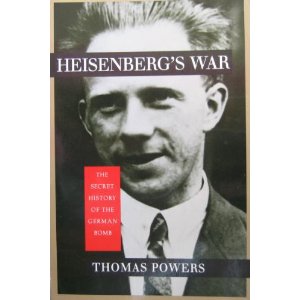
Heisenberg’s War by Thomas Powers

Heisenberg’s War by Thomas Powers - As WW II was about to begin America had gathered in many of Europe’s leading physicists either because they were Jewish or, if German, because they did not want to work in Nazi Germany. Werner Heisenberg, the Nobel Prize winner for the development of his “Uncertainty Principle”, was repeatedly urged during his 1939 trip to the U.S. to leave Germany. He stayed and was the leading physicist in Germany as the war began.

The German physicists who stayed in Germany during the war, led by Heisenberg, wanted to be perceived as avoiding the development of the science needed for the atomic bomb. Early in the war they appreciated the importance of the discovery of plutonium and sent messages, at peril of their own lives, to American scientists that they had sought to “hinder the idea of making the bomb” but expected pressure to work hard on developing the bomb. As common in war the messages were discounted or viewed sceptically.

By the end of 1941 Heisenberg’s experiments had established that large scale reactors could produce plutonium. At this time the Allies and Germans were about equal in bomb science.

It was the Allies good fortune that the leading German physicists were not dedicated Nazis. Led by Heisenberg they did not want to place the bomb in Hitler’s hands.

In early 1942 the critical decisions were made in the U.S. and Germany on developing the bomb. America committed vast resources to the Manhattan Project. 

In Germany Heisenberg at a pivotal meeting with Albert Speer in 1942 stressed the problems in developing the bomb and the probability it could not be developed in time to have a role in the existing war. He was prescient in estimating that America could not develop a bomb for use before 1945.

In the West scientists took the lead in emphasizing the danger of atomic bombs and the risk they were being developed in Germany. The German physicists never stressed the risks of Western development of atomic bombs.

Still had the German physicists led by Heisenberg pushed, as scientists normally do, for massive funding to pursue new frontiers and develop practical applications the Nazis would have had a chance of developing atomic bombs. Speer would have found them money had they indicated a bomb was feasible in the near future. Instead of seeking millions of marks they asked for hundreds of thousands.

In Gitta Sereny’s book, Albert Speer: His Battle with the Truth, Speer says he offered far more but Heisenberg said their research was too far behind America at that point to benefit from much larger amounts of research money.

Heisenberg had a vague idea that the world’s physicists could delay the bomb in every country if they discouraged their respective governments that the bomb was a very expensive project with only potential results long into the future.

German scientists in 1942 again sent messages to the West that their focus was on developing a nuclear reactor rather than the bomb. With most of the messengers and recipients non-scientists once again the messages were downplayed or misinterpreted. Allied scientists and intelligence consistently over-rated German progress. They assumed the same efforts were being made in Germany as in the West.

In hampering German atomic bomb development the Allies correctly identified the production of heavy water in Norway as a key resource. Between sabotaging the plant, then bombing the plant and finally sinking the ship transporting the last major shipment to Germany they prevented any significant quantity of heavy water reaching the scientists in Germany.

There is a long stretch of the book which discusses the American atomic bomb program and the intelligence efforts to gather information on German atomic research.

Most of the intelligence plans sound amateurish. Part of the problem was the reluctance to give any agents information about atomic research to be knowledgeable enough to obtain useful information.

It was interesting to read about the plots, never attempted, to either kidnap Heisenberg or bomb his Institute. A primary reason for not proceeding was the Allies did not want to give notice they considered atomic research important.

I would have preferred the book concentrate on Heisenberg. Still if the book had been solely about his war it would have been a short work. He was engaged quietly in research focused on developing a nuclear reactor rather than a bomb.

Heisenberg had social and scientific contacts with numerous plotters in the 1944 assassination attempt on Hitler. Innate caution kept him just far enough away to escape arrest and execution.

There was a fascinating section on Moe Berg, former major league baseball catcher and polymath, turned OSS agent who was sent to Switzerland in late 1944 and attended a seminar and a meeting at which Heisenberg was present. It was clear his instructions were to kill Heisenberg if he felt the German scientist was involved in atomic bomb research. Fortunately, both for Heisenberg and the relationship of the U.S. with Switzerland he saw no need to pull out his gun when the seminar was a discussion of S matrix physics.

After the war many American scientists, led by Samuel Goudsmidt, mocked the German program and its physicists as never understanding what was needed to build the bomb.

To the contrary, I believe German physicists could have led a bomb building program and had Heisenberg been as committed as Robert Oppenheimer, probably would have progressed faster for Heisenberg had a better mind. At the same time I expect the Allies would have attacked the program by air with even greater vigour than the attacks on the rocket program. I doubt the Nazis could ever have won a race for the bomb.

Moral qualms proceed by degree in war as touched upon in the book. To help end WW II in Japan was it worse to kill hundreds of thousands of civilians through the atomic bombs or through incendiary bombs or through a land invasion? Should weapons of mass destruction have been used to minimize casualties of the attacking Allies?

I liked the book though its title was misleading in that a major part of the book had nothing to do with Heisenberg. The subtitle of The Secret History of the German Bomb better describes the book though far from accurate since there was no German bomb project. Ultimately, it is hard to put together a biography where the subject is not doing more than research at a modest pace with limited resources. (Nov. 2/12)

****

My next post will review a mystery, In Search of Klingsor, involving the German atomic bomb research of WWII.

Monday, November 26, 2012

The Legends of the Lake on the Mountain by Roderick Benns

The Legends of the Lake on the Mountain – An Early Adventure of John A. Macdonald  by Roderick Benns – The Legacy and Leaders series for Young Adults continues with the second book in a series featuring the adventures of Canadian Prime Ministers when they were between 11 and 13 years of age. It is 1828 and young John A. Macdonald, our first Prime Minister, is 13 years old and residing at the community of Stone Mills (now Glenora) in Prince Edward County near Kingston, Ontario.

His father, Hugh, is running a flour mill powered by a waterfall coming out of the Lake on the Mountain, a lake on a plateau above the town.

It is late summer and John is conflicted about his imminent return to school in Kingston. He enjoys life both in the city and in his small home town.

While helping out at the mill there is still lots of time for John and his best friend, George Cloutier, a French Canadian boy to explore the mountain. John generally tolerates his 9 year old sister, Lou, joining them on their adventures. Her only regret in life appears to be that she is not a boy. His older sister, Molly, is more adult than child and uninterested in exploration.

Their quiet community is shaken when a local farmer disappears and his blood stained shirt is found on the edge of the lake. The anxiety level rises when there are reports of a lake monster. It sounds a lot like the Loch Ness monster with a big head and humps coming out of the water.

With John leading the way the young trio of John, George and Lou climb out on the branches of a huge twisted oak. They extend well into the lake. When the boys end up falling into the lake the creature appears in the lake. The terrified trio rush from the lake.

When the local constable also disappears the community is in an uproar over the missing men and the monster of the lake. Amidst the terror John does not panic and seeks a solution to the mysteries of the missing men and the lake.
 
At the same time the young people are entranced by a third mystery involving a French admiral from the time of the Seven Years War almost 70 years earlier.

Politics is already of interest to the young John. It is the time of the Family Compact, a group of elite families, who controlled Canada West (now Ontario) by overruling the legislature when they did not like decisions.

John is opposed to the Compact but, foreshadowing his adult life, does not believe in revolution to achieve democracy. He does not want the American model of revolution adopted in Canada to solve the challenges of dealing with an oligarchy.

John is the acknowledged leader of himself, George and Lou. He is already demonstrating the determination and eloquence and intelligence that made him successful in politics. His cleverness in negotiating with a bully will bring a smile to the reader.

For my adult life my image of John has been of him as the “Grand Old Man” of Canadian politics who led the way in achieving confederation in 1867 founding Canada and was re-elected our Prime Minister a generation later. This book has caused me to reflect on John as a young teenager. Few books look into the youth of the famous of the world.

I enjoyed the book. I thought the mystery in the first in the series, The Mystery of the MoonlightMurder, involving the young John Diefenbaker in Saskatchewan was a better mystery. The Legends of the Lake on the Mountain made me want to read the next in the series which involves a young contemporary Primer Minister, Paul Martin, who is still alive.

I continue to hope all who love Canadian history encourage young adults to read the series. They learn of important issues in Canadian history and how they impacted the lives of young Canadians who happened to be our future leaders. (Nov. 21/12)

****

This book will be my 5th book in the 6th Canadian Book Challenge. I have reached the Double Double level. Each level is named for a Canadian food or drink. Continuing with my single question quiz related to each book in the series does any reader know what a Double Double is in Canada?

Thursday, November 22, 2012

Links to All My Posts in the 2012 Alphabet in Crime Fiction Meme

The 2012 Alphabet in Crime Fiction meme hosted by Kerrie Smith at Mysteries in Paradise has taken me to 26 very different mystery authors. My profiles, reviews of some of their books and some commentary follow. Please click on the title of the post to be taken to the post:
 
1.) "A" is for Rennie Airth;
 
2.) "B" is for Gail Bowen;
 
3.) Kaleidoscope by Gail Bowen;

4.)  "C" is for Robert Crais;

5.) "D" is for William Deverell;

6.) "E" is for Jill Edmondson:

7.) "F" is for Zoe Ferraris;

8.) "G" is for John Grisham - Part I;

9.) "G" is for John Grisham - Part II;

10.) "H" is for Robert Harris;

11.) "I" is for Greg Iles;

12.) "J" is for Stan Jones;

13.) "K" is for Joseph Kanon;

14.) "L" is for Paul Levine;

15.) "M" is for Seicho Matsumoto;

16.) "N" is for Stuart Neville;

17.) "O" is for Gregg Olsen;

18.) "P" is for Edward O. Phillips;

19.) "Q" is for Kwei Quartey;

20.) "R" is for Robert Rotenberg;

21.) "S" is for Josef Skvorecky;

22.) "T" is for Donald Serrell Thomas;

23.) "U" is for Arthur W. Upfield;

24.) "V" is for Michael Van Rooy;

25.) "W" is for L.R. Wright;

26.) "X" is for Qiu Xiaolong Again;

27.) A Loyal Character Dancer;

28.) "Y" is for Scott Young;

29.) Murder in a Cold Climate by Scott Young;

30.) Traditional Outdoor Journeys in Crime Fiction;

31.) "Z" is for Zubro;

32.) The Truth Can Get You Killed by Mark Richard Zubro; and,

33.) 2012 Alphabet in Crime Fiction Meme Roundup.

It is a good time to be reading crime fiction.


Tuesday, November 20, 2012

2012 Alphabet in Crime Fiction Roundup

The 2012 Alphabet in Crime Fiction Roundup hosted by Kerrie Smith at her excellent blog, Mysteries in Paradise, has been fun. In last year’s meme I posted a combination of book reviews and author profiles. This year I resolved to put up 26 mystery author profiles of authors whose books I had read. I was successful.

Depending on which time zone of the world in which you read this post I put up my first post in the meme exactly six months ago, May 21, when I started with “A” is for Rennie Airth.

Over the course of the next 25 weeks I followed with profiles of a wide variety of authors. I chose to have the greatest concentration of profiles of Canadian authors. I had posts on seven Canadian authors:

            1.) “B” is for Gail Bowen;

            2.) “D” is for William Deverell;

            3.) “E” is for Jill Edmondson;

            4.) “P” is for Edward O. Phillips;

            5.) “V” is for Michael Van Rooy;

            6.) “W” is for L.R. Wright; and,

            7.) “Y” is for Scott Young.

In addition to the profile of Gail Bowen I was able to post a review of her newly published book, Kaleidsocope.

The saddest profile of the 26 involved Michael Van Rooy because he sadly died last year of a heart attack at 42. He was just establishing himself as a coming mystery author in Canada when he died.

My profile of L.R. Wright unexpectedly brought to me a very nice comment from her daughter, J. Wright. In that comment she spoke of her mother’s attitude towards the cancer that killed her when she was 61:

About her battle with cancer, she asked us to say that when she died, the cancer died with her. It was a draw.

Having completed seven Canadian profiles and, having a few from last year, I anticipate setting up a page in the near future of an alphabetical list of Canadian mystery writer profiles.

Moving outside Canada there I was introduced to a new pair of writers because I was short of existing authors in “Q” and “Z”. For “Q” I read a mystery of African, now American, writer Kwei Quartey. For the end of the alphabet I read a book by Chicago author, Mark Richard Zubro.

I profiled two authors I had also profiled in the 2011 meme – Qiu Xiaolong and Arthur Upfield. I found a new way to add to my profiles with each author. For Xiaolong I was able to have Q & A over his use of poetry in his mysteries. With Upfield I explored the origins of his character, Napoleon “Bony” Bonaparte and found he had been less than candid in his official explanations.

It turned out that “N” for Stuart Neville has become the most popular post I have put up on the blog as it found its way into the top of some search engines. There have been thousands of page views of the profile.

Out of the 26 profiles my favourite is “Y” is for Scott Young. I had known Young as a sportswriter and a novelist of young adult hockey fiction but never knew he had written any mysteries among his 40 plus books. It was a good surprise to find he had written two mysteries set in the Canadian  Arctic. I enjoyed Murder in a Cold Climate and appreciated Young making his sleuth the first Inuk RCMP Inspector, Matthew “Matteesie” Kitogitak, and refreshingly normal in appearance.

My next post will provide links to all my posts for the meme.

Thanks again Kerrie for hosting this meme which has enriched my reading of mystery fiction.