About Me

My photo
Melfort, Saskatchewan, Canada
I am a lawyer in Melfort, Saskatchewan, Canada who enjoys reading, especially mysteries. Since 2000 I have been writing personal book reviews. This blog includes my reviews, information on and interviews with authors and descriptions of mystery bookstores I have visited. I strive to review all Saskatchewan mysteries. Other Canadian mysteries are listed under the Rest of Canada. As a lawyer I am always interested in legal mysteries. I have a separate page for legal mysteries. Occasionally my reviews of legal mysteries comment on the legal reality of the mystery. You can follow the progression of my favourite authors with up to 15 reviews. Each year I select my favourites in "Bill's Best of ----". As well as current reviews I am posting reviews from 2000 to 2011. Below my most recent couple of posts are the posts of Saskatchewan mysteries I have reviewed alphabetically by author. If you only want a sentence or two description of the book and my recommendation when deciding whether to read the book look at the bold portion of the review. If you would like to email me the link to my email is on the profile page.

Saturday, November 5, 2016

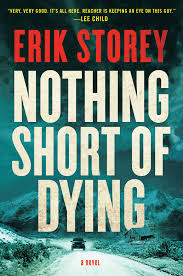
Nothing Short of Dying by Erik Storey

Nothing Short of Dying by Erik Storey – Colorado born Clyde Barr returns home after 16 years in hot and troubled lands. He has spent those years not exactly a mercenary, not quite a freedom fighter, certainly not a soldier. He is a violent idealist willing to fight for those who have been victimized by the cruel and greedy. During those long years he has been involved in more than his share of killing. Most recently he spent a few years in a Mexican prison where his sense of honour almost got him killed.

Back in Colorado he is enjoying some time alone in the mountains and contemplating heading to the Yukon. Barr is not much interested in spending time with people.

His plans change when he gets a cryptic phone call from his sister, Jen. She is in trouble and needs him. They have a special relationship forged in the horrors of growing up with a drug addicted mother who brings home a string of vicious boyfriends. While he ran away after high school she stayed in Colorado often using drugs as her personal escape. Barr owes her and will help her.

A few phone calls and it is clear she is with a major drug dealer and in real danger. Barr sets off on a quest to rescue Jen.

Unlike many current action heroes he is not so stubborn as to act on his own. He seeks out a professional gun man for support and gains an unlikely ally in Allie, a lovely bartender from a dive he stopped at to ask a few questions.

His investigative skills are almost exclusively violent. I thought of Joe Pike from the mysteries of Robert Crais. Barr is a touch less taciturn than Pike but certainly his equal in body counts.

Nothing Short of Dying is easy reading. Storey keeps the narrative rolling yet it is hard to turn a major meth making villain into an interesting character. As with most current thrillers the evil one is pure evil.

Nothing Short of Dying is a thriller where it is best not to weigh the reading down with thinking. Let the action flow.

There is a potentially interesting character in Barr were more time spent on developing him and less on action sequences. He occasionally reflects on where he has been and where he might go with his life.

I think Storey has the ability to write thrillers. It would be great if he could ease away from the customary high body counts.

If you are looking for a fast paced thriller with black and white characters you will enjoy Nothing Short of Dying. Lee Child, William Kent Kruger, C.J. Box, Nelson DeMille, Lori Armstrong, Craig Johnson and Jeffery Deaver all provided glowing blurbs.

Thursday, November 3, 2016

Louise Penny and Michael Whitehead Holding Hands

A few weeks ago I put up posts about Louise Penny’s new book, A Great Reckoning. At the close of the book Louise set out all the people who had helped her be able to write the book as she coped with the increasing dementia problems of her husband, Michael.

Last week author, Anthony Bidulka, shared on Facebook an article Louise wrote for the AARP. It can be found at http://www.aarp.org/home-family/caregiving/info-2016/mystery-writer-louise-penny-personal-essay.html

Focused on caregiving the article discusses how Louise and others cared for Michael.

I was reminded of a day at our Rotary Club in Melfort when a member told us about the journey of himself and his wife in dealing with her early onset dementia in another community. As her health declined he advised his club in that city that he would have to give up his membership as he could not leave her alone to come to meetings. With a catch to his voice he said the wives of his fellow members (at that time Rotary was mainly male) organized themselves to be with his wife for each meeting so he could have abit of time with his friends.

Louise's article is titled “The Last Promise”. She promised herself that she would be with Michael when he died holding his hand.

It is a heart wrenching story. I admire Louise for writing about their challenges and for her commitment to Michael.

After the article there was a note that Michael had died on September 18 and that Louise had been able to fulfill her last promise.

Peace be with you Louise and Michael.
 

Monday, October 31, 2016

The Letters of Jack McClelland

Jack – A Life with Writers by James King – My last post reviewed the biography of Canadian publisher, Jack McClelland. Reading about his life was interesting but what was best were the excerpts from his letters, especially to authors. Jack was never a remote publisher. Some quotes from his remarkable letters form this post.

He could be very blunt. In a letter to Farley Mowat on a proposed foreword:

And secondly, I think it is badly overwritten. Some of the phrases and some of the pictures that are conveyed are extremely good, but it’s too contrived and a bit too purple for my liking, and I think you should tone it down so that it will read more smoothly ….. It’s far better than I would expect to see from another author. It’s terrific, fabulous and fantastic, but it isn’t your best work and needs further effort. In short, it’s none too good.

In a letter to poet to Earle Birney, over a critical interview Birney gave in England, he was furious and forgiving in the same letter:

You son of a bitch, I would be far more inclined to agree to give books away on your behalf if you wouldn’t involve yourself in such vicious and incredibly stupid interviews as the one that appeared in Smith’s Trade Journal. I would like to think you are misquoted, but I am sure that you weren’t, and I think you must have taken leave of your senses. What the hell have you got against Canadian publishers? ….. As usual, I forgive you.

When poet Irving Layton complained about Jack not being willing to publish books commissioned by the publisher on Layton's work but which Jack considered not publishable the reply to Layton was graphic:

Are you really all that bloody insecure? I could vomit. Let’s get a few things straight and on the record ……Another thing I should tell you, old friend, is that the most important thing that your poetry accomplished in this country is to make poetry respectably unrespectable. Of if you prefer, unrespectably respectable. Poetry in Canada used to be in the hands of old ladies and the odd gifted human being like Bliss Carman ….

To save time in responding to some author complaints in the 1970’s:

Jack had a “Bullshit” stamp made and sometimes used it on missives received from Pierre [Berton].

He could be playful. He wanted Christina Newman, wife of author Peter Newman, to write a biography but she was concerned with the demands on her time of a hyperactive 3 year old child and her hyperactive demanding 38 year old husband. Jack wrote back:

We would be prepared to make a sufficient advance to look after babysitters, housekeepers, and even, for God’s sake, a mistress for Peter if that would help.

He could be humorous while making a point. In a letter to the Toronto Star newspaper:

When the paperback manager of Canada’s largest ‘books only’ chain [Classic Books] makes disparaging comments about three of Canada’s most distinguished authors – Margaret Atwood, Pierre Berton and Farley Mowat – while drooling over [the American prostitute-turned-author] Xaviera Hollander it is time to call a halt …. I propose that we use the term ‘koob’, book spelt backwards, to describe the sort of impressions from a police blotter that Ms. Hollander writes … Please don’t misunderstand me. I like junk reading. I’ve sold a lot of koobs in my day and plan to continue to do so, but I do respect books and I think a distinction must be made.

Many authors contacted to him as they were upset over negative reviews of their books. To Pierre Berton he wrote:

          Don’t read the reviews! Measure them!

He could write moving letters of appreciation. He wrote to Gabrielle Roy:

Have I ever told you that you write the most beautiful letters I ever receive? I am often tempted to bother you with a string of letters just so that I can have the replies. Why should I be surprised, though? As I have told you so many times, you are the greatest writer in the country, and it is not surprising that you should write such lovely letters.

And lest authors think submission letters are not important King provides an anecdote involving American publisher, Alfred Knopf:

He once told Jack that a secret to a book’s success could often be found in the letter that accompanied a manuscript: “If they can’t write a good letter, how can they write a good book?”

I doubt you can find a publisher today who writes letters with the verve, passion and style of Jack.

Thursday, October 27, 2016

Jack – A Life with Writers by James King

Jack – A Life with Writers by James King (1999) – If asked to name a Canadian publisher my first thought is Jack McClelland even though he left McClelland & Stuart 30 years ago. His drive and personality made him the face of Canadian publishing for 40 years. He published over 2,500 books.

His father was a founder of the company. After serving as a motor torpedo boat commander in the Canadian Navy during World War II Jack entered the family business in 1946. His nickname of “Sonny Boy” grated.

On his publishing goal:

He shared his father’s innate conviction that publishing was a belief in and commitment to his Canadian culture.

He became a Canadian nationalist in book publishing when McClelland & Stuart lost over half of its sales and income because the American publisher, Doubleday, severed their agency relationship and set up a Canadian subsidiary.

Though Canada has always been inundated by American published books Jack was determined to publish Canadian authors. It was a financially perilous quest that needed infusions of government money to survive.

Getting Canadians to read Canadian authors even as much as American and English authors has been difficult for publishers. I see it no different today. Yet Jack never wavered. Over the course of his career he published most of Canada’s best known authors.

In fiction his authors included such strong women writers as Gabrielle Roy, Margaret Laurence and Margaret Atwood. There were non-fiction authors such as Farley Mowat, Pierre Berton and Peter Newman. Among his poets were Earle Birney, Irving Layton and Leonard Cohen.
 
His attitude towards poetry was striking:

I would say that we publish Canadian poetry first and foremost because we are Canadian publishers and we still consider poetry one of the most important forms through which the creative writer may express himself.

He published poetry despite the financial consequences:

We inevitably lose money even on a relatively successful volume because the market is at best a confined one.

He was a publisher involved in the “reading, acceptance or rejection of manuscripts”. On assessing books:

He once said, “I can usually tell if manuscript is good, but I can’t tell why." He responds to books intuitively, which has made him an unusually receptive reader.

An illustration of this approach was set out in my recent post on the author, Patricia Blondal, where he stayed up until 3:00 in the morning reading her book, A Candle in the Sun, and then met her that day for a lunch that lasted all afternoon.

For Jack authors were at the heart of publishing:

“We are middlemen offering a service to writers. It is a service business. We serve well or not. If we let them down we hurt ourselves, just as in any other service industry ….. You can make almost any mistake at M&S and be given another chance – rudeness or arrogance in dealing with authors – no matter who they are – I will not tolerate.”

I wonder how many authors today feel their publishers so value them.

While he may have been privately shy, flamboyant barely encompassed his public persona.

His promotions could be outrageous. Can anyone think of another publisher who, on a snowy March day, would dress in a toga and gold laurels to join author, Sylvia Fraser, dressed in a glittering silver dress, to go by horse drawn chariot to visit Toronto bookstores to promote her book, The Emperor’s Virgin? And when the chariot broke down, the never daunted the sandal shod Jack trudged with Fraser through the snow to visit the bookstores.

In the early 1980’s Jack assessed himself:

“I have never been a superrealist. I have been an enthusiast, an optimist, a problem simplifier – never a super-realist or even much of a realist.”

I regret I never met him.

The best parts of the book were excerpts from letters he wrote to authors. My next post will discuss and quote those memorable missives.

King does well in describing Jack the publisher but the book is a touch worshipful to be a convincing biography. It leans to the style of official company biographies commissioned by large corporations. Clearly charmed by Jack I wish he had showed more candour.

Friday, October 21, 2016

Reflections on Patricia Blondal and A Candle to Light the Sun

I knew before starting to read A Candle to Light the Sun that the author, Patricia Blondal, had died of cancer a short time after learning the book would be published. As I read and loved the book thoughts of her death were never far away. There was a poignancy to the loss of such a great talent so young that made the reading an emotional experience. 

It felt an especially cruel irony to read that her husband, Harold Blondal, was a doctor specializing in cancer treatment.
 
Learning she spent three months apart from her family, while dying, to write the book left me wondering what I would do were I faced with a prognosis of but a few months to live. 
 
Her heart was clearly poured into the book. In an introduction to my edition of the book Patricia Demers quoted from a comment Blondal made to a reporter about her characters: 
 
“I sometimes lie in bed at night and hear them talking, see them walking and reacting, laughing and crying. After getting to know them so intimately it’s easy. They handle the plot.”
 
My favourite Saskatchewan novel is Who Has Seen the Wind by W.O. Mitchell. As with A Candle to Light the Sun it involves a boy growing up on the prairie in the desperate 1930’s. In both books the wind is a constant companion.
 
In A Candle to Light the Sun:
 
She had gone half a block before she realized how tired she was, how terribly tired, how strong the wind. Her eyes were full of dirt, the streets long gray cocoons of winding wind and soil, all the houses shut tight against the unnatural dark …… The two boys were wild with the torrent of the wind, filled with the immense surge of it as they ran along the rim of the valley. Below them, as if they were looking through smoked glass, they could see the long grass bending under the weight of the wind and far off the oaks plunging together in its fury.
 
Among those inspired by Blondal was Benjamin Herson, a rabbi in Malibu, California, who grew up in Manitoba. Herson had a vivid memory of seeing the beautiful Blondal in a hallway during university. In a Globe & Mail article in 2002 he said:
 
"There was a deep and electrifying communion, a wonderful magic moment of enchantment," he recalls. "I fell in love with that woman pure and simple and here I was the son of a rabbi, studying in a college sponsored by the United Church."
 
Shortly after Herson was diagnosed with tuberculosis and never saw Blondal again.
 
Almost 40 years later a student gave him a copy of A Candle to Light the Sun. Up to that moment he had not known she had written a book and died so young. He connected deeply with the book and wanted to honour her memory:
 
That question brought Herson back to Manitoba where he and Blondal had grown up in separate worlds. He bought a simple farmhouse outside Gimli, Man., a 10-minute walk from the shores of Lake Winnipeg, and in 2001 he worked with the Manitoba Writers Guild to inaugurate it as the Patricia Blondal Memorial Writers' Retreat. It contains Blondal's two posthumously published books, photos, a poem and a display about her, a modern kitchen, woodstove and guest rooms. Three established Manitoba writers have already sat down at its expansive desk for a quiet month each of wordsmithing.
 
And to think Herson fell in love with Blondal and felt this deep connection despite never having spoken to her. 
 
Blondal’s final words in A Candle to Light the Sun will remain long in my memory:
 
      Roselee put her arms around him, for it was time to mourn and mourning in
      Mouse Bluffs must be done in private, spoken gently against the tender green
      of the valley, lest the wind, hearing, should tear it to tatters against the great
      sky.
**** 
Blondal, Patricia - (2016) - A Candle to Light the Sun and Patricia Blondal

Wednesday, October 19, 2016

Patricia Blondal

Patricia Blondal created powerful first impressions. Publisher Jack McClelland in Jack – A Life with Writers by James King:

Sometime in [1959] I received a phone call from Winnipeg. The caller was a woman by the name of Patricia Blondal. The message was clear: “I sent a manuscript to your company almost a month ago and I have heard nothing. I’m arriving in Toronto tomorrow morning and if you don’t want to publish it and have not made a decision by then, I’ll withdraw it and submit to Macmillan …” It was after-hours and I decided to look around and see if I could find the manuscript. I finally located it in a pile of [mainly] unread material. At around eight o’clock my wife called and asked why I wasn’t home for dinner. “I’m really sorry, dear,” I apologized, “but I’m reading a manuscript. I have to finish it, and I won’t be home for dinner.” I arrived home about three in the morning. I found Patricia Blondal’s novel, A Candle to Light the Sun, powerful and gripping. It was the first gutsy, rough Canadian novel I had read.

Pat Blondal called from the airport, and we arranged to meet at noon for lunch at the Royal York Hotel. We were still in the Imperial Room at five-thirty that afternoon. She was articulate, intelligent and strikingly beautiful, and I was stunned by the woman. Later I learned that she had been the campus beauty queen, envied by many of her classmates. She also happened to the top student. I decided to publish A Candle to Light the Sun at the earliest possible date. I offered to marry her too, if that was a requirement, but I pointed out that I would have to get permission from my wife.

McClelland was not the only reader powerfully affected by the book. One of Blondal’s classmates at university was the famous Canadian author, Margaret Lawrence, who stated in a letter to a friend in 1960:

I think her novel is really one of the best things on a prairie town that I’ve read, and it is much more as well ….

Lawrence’s comments are even more impressive in the context of her university relationship with Blondal:

Peggy (Margaret) had in fact been jealous of her classmate’s magnetic sex appeal.

To write the book Blondal, married to a doctor with two children, left her husband and sent her children away to visit family. Three months later she had written A Candle to Light the Sun.

Her intensity to write and be published were driven by terminal illness. Suffering from breast cancer she wrote in a race against death. She died at 32 knowing her book would be published.

For McClelland there was a regret to last the rest of his life:

Jack was haunted by that death. At a dinner in hour of Irving Layton, Blondal had felt “compelled to talk about the re-emergence of her cancer. ‘For God’s sake, Pat,’ I pleaded, ‘we’re here tonight to honour Irving Layton. I really don’t want to hear about cancer.’ She survived for less than two months after that party. I’ll carry the mark of that insensitivity to the grave.”
****
Blondal, Patricia - (2016) - A Candle to Light the Sun

Monday, October 17, 2016

A Candle to Light the Sun by Patricia Blondal

A Candle to Light the Sun by Patricia Blondal – The Great Depression of the 1930’s left millions unemployed and devastated the world economy. Its effects were magnified in rural Western Canada. In addition to the economic disaster engulfing the world the farmers and residents of small towns endured an almost decade long drought.

In fictional Mouse Bluffs, Manitoba, the setting for A Candle to Light the Sun the Great Depression lies heavy upon the community. Money is more often measured in quarters than dollars.  

The residents are dominated by a rigid pride that hates obligation. No matter how poor they must be self-sufficient. Every decision must be weighed against its cost. The grinding poverty wears upon relationships.  

An offer to young David Newman to join the better off minister’s family (Daniel and Solveg Backhouse and their daughter Lilja) for a two week vacation is reluctantly and grudgingly accepted. His parents’ sense of indebtedness is eased when the minister asks his father to check on the house while they are gone. 

David’s mother, Muriel, refuses to see Dr. Gavin Ross about a persistent cough because of the cost. To let him examine her without charging is unacceptable. 

Among those more lightly touched by the Depression are Dr. Ross and his wife, Christine. She is the granddaughter of the town’s founder, Richard Rashleigh, who had sought to re-create an English town on the prairie. They live in a large home, suitably grand for a member of the upper classes though they are its only members in Mouse Bluffs. Personal tragedy has crushed Christine. She cannot and will not find a way to move ahead with life. 

Sharing the home is Ian Ross, a World War I war hero, who has bad lungs from mustard gas and is a paraplegic because of a bullet in his spine. As with many officers of his generation he is a very literate man. He spends his life waiting to die. While waiting his primary avocation is drinking. 

At the other end of the spectrum is the Yeates family. Jack is an unsuccessful gambler and a mean alcoholic. His family lives in an abandoned store that would have been condemned in any other era. To pay off his gambling losses he sends out his wife, Phoebe, to visit the men to whom he owes money. 

David has a dependant relationship with Darcy Rushforth, the privileged nephew of Ian and Gavin Ross. 

And then one sweltering summer night with a prairie dust storm blasting through the town a series of events shatter Mouse Bluffs. The secrets of that night will blight the lives of all involved. 

The book resumes with David in university in Winnipeg at the start of World War II. I can relate to his discomfort with city living after a life in a community where everyone knows you. 

A Candle to Light the Sun deals with an unusual university dynamic which I have not read about in Canadian fiction. Male students are disappearing from campus as they join the Canadian military. There is an unease about the men left at home like David who feels a stigma that he is not part of the war effort even though physical issues have kept him out of the forces. Blondal’s insights into the lives of young men and women at university during the war are compelling. 

David grows physically older through the war. Maturing emotionally is more difficult. 

The relationship between David and Darcy becomes even more complex as they seek independence in their lives after the war but decide to live together. 

There were sudden gaps at times in the narrative. While reviewers at the time thought the two books in one worked well I think it would have been best as two full books. Why there may only have been one book will become clear in my next post. 

Blondal has a wonderful descriptive power of both the land and personal relationships which will part of a third post. I knew she had grown up in a small prairie town even before I read she was born in Souris (the French word for mouse), Manitoba. 

It is an excellent book about relationships, especially male relationships, that a reader, not knowing when it was written, might have thought it was authored this century rather than almost 60 years ago.

Tuesday, October 11, 2016

New to Me Authors for July to September of 2016

Kerrie Smith at her fine blog, Mysteries in Paradise, hosts New Authors each quarter.

For the third quarter of 2016 my reading of new authors emphasized legal mysteries, mainly because I was reading the shortlist for the Harper Lee Prize for Legal Fiction.

The authors were:

1.) Open Season by Peter Kirby

2.) Tom & Lucky and George and Cokey Flo by C. Joseph Greaves

3.) Pleasantville by Attica Locke

4.) Snow Falling on Cedars by David Guterson

5.) The Honest Folk of Guadeloupe by Timothy Williams

Out of the group my only real disappointment was The Honest Folk of Guadeloupe. I found it a tough read and I barely finished the book.

Most quarters Attica Locke for Pleasantville would have been my choice for best new author. Pleasantville was a fascinating look at a black lawyer drawn into the complexities of a community, Pleasantville, designed for and inhabited by black upper middle class families. The book is aptly named in honour of the community.

I was so interested in the lawyer, Jay Porter, that I looked for and found in one of the Fair's Fair used bookstores in Calgary a copy of the earlier book, Black Water Rising, that Locke wrote with Porter as the lead character.

Locke was not favourite as this was not an ordinary quarter. Snow Falling on Cedars is an extraordinary book. The story involving the murder trial of Kabuo Miyamoto, a Japanese fisherman, accused of murdering Carl Heine Jr. is an American saga.

The painful consequences of the internment of Japanese Americans during World War II are at the heart of the book. I liked the book so much I wrote four posts about it. It is the leading candidate for my Best of 2016 Fiction.