About Me

My photo
Melfort, Saskatchewan, Canada
I am a lawyer in Melfort, Saskatchewan, Canada who enjoys reading, especially mysteries. Since 2000 I have been writing personal book reviews. This blog includes my reviews, information on and interviews with authors and descriptions of mystery bookstores I have visited. I strive to review all Saskatchewan mysteries. Other Canadian mysteries are listed under the Rest of Canada. As a lawyer I am always interested in legal mysteries. I have a separate page for legal mysteries. Occasionally my reviews of legal mysteries comment on the legal reality of the mystery. You can follow the progression of my favourite authors with up to 15 reviews. Each year I select my favourites in "Bill's Best of ----". As well as current reviews I am posting reviews from 2000 to 2011. Below my most recent couple of posts are the posts of Saskatchewan mysteries I have reviewed alphabetically by author. If you only want a sentence or two description of the book and my recommendation when deciding whether to read the book look at the bold portion of the review. If you would like to email me the link to my email is on the profile page.

Saturday, May 1, 2021

Marian Misters Bookseller and Award Winner

Just over a week ago the Crime Writers of Canada announced the shortlists for the 2021 Awards of Excellence. In addition to the shortlists the winner of the Derrick Murdoch Award was announced. I am proud to say I have known the winner, Marian Misters, for over 30 years. The CWC stated:

The Derrick Murdoch Award is a special achievement award for contributions to the Canadian crime writing genre. As co-owner of Toronto’s Sleuth of Baker Street, Marian Misters has been supporting mystery authors since the bookstore opened and CWC from its inception. Through hosting book events, she has helped launch the career of many CWC authors. In addition, Marian served as Jury Chair for the Awards four years, during which time she streamlined and developed written procedures for the judges. She was also instrumental in guiding CWC to a new, more diverse, Jury Selection Committee format, and has been active on the Awards Committee for five years.


I called to congratulate her on the well deserved Award and we chatted about her life.


Marian was born in England and moved to Canada when she was 11. With her Dad being moved around in the grocery business she attended 17 elementary schools and 4 high schools. She never understood people at university having kindergarten friends.


Marian and J.D. Singh became a couple at the University of Waterloo where they were in a co-op program and trained as accountants. After graduating they worked for a time with accounting firms. 


Neither enjoyed accounting. She said J.D. hated it. They looked at business opportunities far from accounting including a popcorn franchise and a printing business.


One day they saw a 2 line ad in the Globe and Mail newspaper offering a bookstore for sale. Intrigued, they went to see Judy Lelkes at her store on Bayview Avenue in Toronto.


Marian said when she walked into the store she instantly knew she needed to have this store. It was the place for her. They made an offer. There was a competing bid. The balance tipped in their favour when they wanted to keep on Bill who worked at the store. The owners did not want him to lose his job. Marian and J.D. wanted him because of his vast knowledge of crime fiction. Bill read 12 books a week. 


While Marian was a reader when they acquired the store her knowledge of mysteries was more limited. She said she acquired her knowledge of mysteries on the job.


Her reading has evolved over the years. Initially she read lighter crime fiction such as cozies. Now she reads across the spectrum. She said she has little interest in psychological crime fiction, having no desire to be scared and no need to read writers playing with the reader’s mind. She is ruthless with regard to her commitment to a book. If it has not captured her in 50-75 pages she moves on to another book. If she does not like the characters she does not like the book.


Favourite authors include Louise Penny and Michael Connelly.


Marian has an endless supply of author stories. I think she should write a book about her experiences with writers.


She said Mark Billingham, while writing taut psychological crime fiction, is a stand up comic and a great person.


Much of her reading is done in her chair in her cottage at her lake. Between martinis and walks with her dog, Pixie, she will read 5-6 books a week.


Back at the store her reading is limited. Marian and J.D. have arranged a unique schedule. The store is open 4 days a week from Thursday through Sunday. They alternate weeks. Marian said she goes hard from morning to night for her days and then has 9-10 days before she returns to the store.


Sleuth has always been a special place for me. Readers are greeted. Discussions over books with J.D. and Marian are encouraged. Beyond the welcome there is a charm to their store, especially their second store on Bayview where there was a rolling ladder along high rows of books and a fireplace. She said they sought in that store to create the feel of an English manor library.


At all 3 of their locations over the past 39 years they have sought to make the store comfortable. They have carpet on the floor. There are furniture tables on the floor to hold books rather than utilitarian tables. They do not want an industrial look. She said they wanted a cozy atmosphere for work. She joked she sprays eau de book every morning. 


I recounted in my first post on the store how inviting Sleuth was to our son Jonathan when he was about 12-13:


On one memorable winter visit Jonathan curled up in a chair before the fireplace, was so engrossed in his book that his runners started smoking before he realized he was too close to the fire.


Marian and J.D. have a distinctive relationship. They were married for 20 years. They have been divorced for 22 years. Economics and loving the store kept the business partnership together. Neither could afford to buy out the other nor did they want to sell or close the store. Currently Marian rents a room in J.D.’s home when she is in the city.


As the pandemic continues they are providing curbside pickup to shoppers who can come to the store and mailing out books to online buyers. I just put in an order for the shortlist for this year’s CWC Best Crime Novel.


I do not think I have ever seen Marian without a smile. 

****

Sleuth of Baker Street and Update on Sleuth and 2012 Trip to Sleuth and Sleuth of Baker Street in Mid-winter of 2015 and Authors at Sleuth and A Quintet from Sleuth in Toronto, Ontario whose website is http://www.sleuthofbakerstreet.ca/


Tuesday, April 27, 2021

An Exchange with Martin Edwards on Mortmain Hall

I enjoyed reading Mortmain Hall by Martin Edwards, the justly well known English author / expert on Golden Age crime fiction / solicitor. It took me some time but I wrote to him recently. I appreciated his prompt thoughtful reply. Our exchange is below.

****

Dear Martin: 


The title of Mortmain Hall caught my attention.


As I read the book I vaguely remembered “mortmain” had some legal meaning but it was not until I was done and happened to be reading the review by Vicki Weisfeld in the blog, Crime Fiction Lover, that I appreciated it was an ancient legal term related to the gifting of land.


The literal translation of ”dead hand” is so evocative.


It has been 49 years since I studied Legal History in law school and I doubt mortmain was a part of my first year studies at the University of Saskatchewan. Our focus was on the Rule Against Perpetuities.


Looking at online definitions I learned “mortmain” actually dealt with legislation, the Statutes of Mortmain in 1279 and 1290, attempting to prevent the gifting of real estate to ecclesiastical organizations where it would stay forever. It was interesting to read how lawyers of that time created forms of trust to evade the limitations in the Acts.


As I went on with some historical searching I found the 1736 Statute of Mormain passed during the reign of George II in which limitations were placed on donors, whether in their lifetimes or by will, to make charitable gifts.


What was unexpected to me was finding 18th Century statute being considered in a Saskatchewan estate case 100 years ago in the 20th Century. When the vast areas of the NorthWest Territories owned by the Hudson Bay Company in Western and Northern Canada officially became part of Canada in 1870 English statutes “in so far as the same are applicable to the Territories”, unless replaced by subsequent English or Canadian statutes, remained in effect.


Saskatchewan became a province in 1905. In 1918, in Re Miller Estate a Saskatchewan judge dealt with the interpretation of a will containing the following clause:


“to Mrs. Jennie Delaney of 89 Marion Street, Toronto, for Christian work or otherwise as she sees fit.”


Judge Elwood determined the 1736 statute did not render the bequest void as he concluded the statute did not apply to the Territories from which Saskatchewan formed. He mainly relied on cases from the West Indies that the statute was only intended to prevent “public mischief” in England and had no effect when not adopted by the Legislature of Saskatchewan.


In a final twist he still found the bequest void for uncertainty.


In my general law practice, which includes work as a barrister and a solicitor, I prepare wills. In the wills I have drafted I have been successful in persuading clients not to seek to rule lives far into the future by their “dead hands”. In recommending against long term trusts I refer to the unknown length of time they will be in place and the limitations on the lives of beneficiaries and unexpected consequences. I often refer to a file I handled as a young lawyer.


In the early 1980’s I was dealing with an estate in which a payment was deposited from England once a year into the bank account of the deceased in rural Saskatchewan. His family did not know the reason for the payment. Through the mails, in those distant days before electronic communication, it was determined it was interest from a war bond. What startled me was that it was a WW I war bond! Apparently the English government was content to pay modest interest on a bond for over 60 years after the end of the war. Further research determined that it had been purchased by the estate of the deceased’s wife’s father. That information meant further research into English court records which determined the will of the wife’s father had been written by hand in the 1880’s (I understand important documents were written at that time rather than typed as commercial typewriters had only been sold for about 10 years). The will provided that the interest from any bonds in his estate went to his daughter and upon her death to her husband and upon his death to some English relatives. Since the ultimate disposition did not involve my Saskatchewan clients I did not try to find out who ultimately received the funds in England. 


I am confident no will I have drafted will be administered during the 22nd Century.


I enjoyed your drawing on real life cases in Mortmain Hall. After my review of the book I wrote about the Rouse case which I believe was your inspiration for the fictional Danskin case. I had intended to write this letter earlier but did not get my intentions completed until now. Was I correct that the Rouse case inspired you? Links to my posts are below.


Will you continue to work real life cases, legal phrases and concepts into your books? I hope you will continue to draw upon past legal history.


I will post this letter in my blog in about a week. If you are able to reply and willing to let me publish your response I would put it in that post or a later post.


I admire you for the breadth of your knowledge and writing talent and having carried on an active law practice while being a writer.


All the best.


Bill Selnes


****


Hi Bill


Thanks very much for this interesting email. I’m delighted that you enjoyed the book, and I hope that Gallows Court – which is deliberately rather different in style – will also appeal to you.


What I try to do in all my books, to a greater or lesser extent, is to include a wide range of elements that I hope will entertain and amuse (and perhaps, just occasionally, inform) and give the story a distinctive personality. My starting assumption is that, with each book, a ‘typical reader’, if there is such a person, will not necessarily pick up on everything that is there, lurking beneath the surface, but my hope is that there will be enough there to carry most people happily along. Over the 30 years since I published All the Lonely People, my first novel, I’ve been fascinated to see the way that readers have reacted, and the different ways in which different readers and reviewers have responded to those elements.


So my idea with my Harry Devlin books was to combine a gritty contemporary urban setting with an over-arching exploration of a city in the course of recovery from social and economic calamity, and with plots and tropes from the Golden Age. Intriguingly, hardly anyone ever picked up on the GA elements, probably because that type of writing was out of fashion at the time. When I made the GA aspects even more obvious, in The Devil in Disguise, my original publisher rejected the book, since she only liked the gritty elements and wanted more of the same. Fortunately, Hodder snapped it up, but although I’m fairly philosophical about these things, I was surprised that even though the books were in general very well received, so few people recognised what I was really trying to do.


So I tried writing other types of crime novel and trying out other ideas. Take My Breath Away was set in a London law firm and combined a psychological thriller with a satire of the Blair government and the PR business. Dancing for the Hangman was an attempt to provide a psychologically credible explanation of the puzzling aspects of the Crippen case. The Lake District Mysteries deal, among other things, with the nature of life in rural England in the present century and the geography and literary heritage of the Lakes. And so on.


The idea under-pinning the Rachel Savernake books is to take GA and psychological thriller plot ingredients, a Gothic dimension, a study of England in the 30s, and…well, you get the picture. These books are obviously much darker than the typical GA mystery and have a wide variety of ingredients. I was pleasantly surprised to read one blog article discussing ‘drink’ in Mortmain Hall, which made me rather glad that I’d done my homework, and I continue to enjoy the wide range of responses.


I chose the word ‘mortmain’ partly to create atmosphere, but partly to give a clue to the main strand of plot. One of the main ideas was to write a detective novel in which it is far from obvious what central mystery the reader and detective have to solve, and ‘mortmain’ was a sort of hint. Although I’m a solicitor, I’m not an expert in wills or property law, and my main recollection of the rule against perpetuities is of attending a lecture at Oxford on the subject which to a 19 year old was less than enlivening. So I consulted my son, a Chancery barrister, whose input was valuable in getting the facts and law right.


You are right to think that the Danskin trial drew on the Rouse case. As you have no doubt gathered, various other real life cases inspired other elements in the plot, such as the Mahon case, the Thompson-Bywaters case, and the Wallace case. I was also interested to try out various ideas about story structure – starting with an epilogue, the cluefinder, having a lengthy build-up before the characters arrive at Mortmain Hall, and so on.  


The next Lake District Mystery, The Crooked Shore, takes an idea from a recent high profile murder case, but the storyline is very, very different. One of its elements is to resolve a puzzle mentioned in the first book in the series, more than fifteen years ago.


I’m currently close to completing the next Rachel Savernake book, Blackstone Fell, and  it will explore the connections between science, religion, rational thinking, and spiritualism – among many other ingredients, including a locked room mystery. There are again one or two legal elements, but these are in the background.


Thanks again. I’m always grateful when people take the trouble to discuss my books in a positive way – it’s very rewarding. I received one delightful and amusing email recently from a reader who had figured out the hidden connection between the names of many of the characters in Gallows Court, but that’s another story…


All the best

Martin

****

https://mysteriesandmore.blogspot.com/2020/12/mortmain-hall-by-martin-edwards.html

https://mysteriesandmore.blogspot.com/2020/12/a-real-life-case-and-mortmain-hall.html


Saturday, April 24, 2021

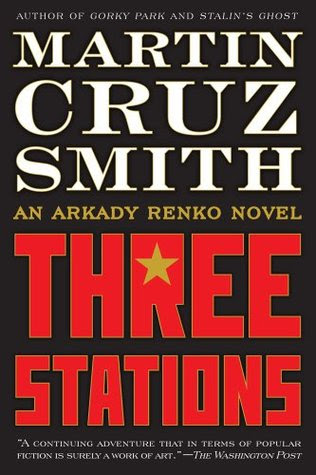
Three Stations by Martin Cruz Smith

(13. - 1085.) Three Stations by Martin Cruz Smith (2010) - Arkady Renko has been neutered:

He was an investigator who investigated nothing. The prosecutor made sure Arkady followed orders by giving him none to defy. No investigations meant no runaway investigations. Arkady was ignored, welcome to spend his time reading novels or arranging flowers.


He is nominally assigned to the area including “Komsomal Square, the people of Moscow called Three Stations for the railway terminals gathered there. Plus the converging forces of two Metro lines and ten lanes of traffic”.


Zhenya, the teenage boy who calls Arkady his friend and occasionally stays in Arkady’s apartment, is at the Three Stations daily looking for chess games and studying a Russian-English dictionary in a reversal of Bobby Fischer who learned Russian to read chess analysis. Known as “Genius” Zhenya hustles and observes and lives in a shuttered casino.


Zhenya becomes Maya’s protector. The 15 year old Maya from some distant part of Russia east of Moscow, has had her 3 week old baby stolen just before the train arrived. Exhausted from the journey she had fallen asleep.


Desperate to find her baby she is adamant about not seeking police help after her initial report is dismissed as a lie.


Arkady blunders into the investigation of the death of a young teenage woman near the Three Stations. She was found in a trailer with a direct phone line to the nearest police station. If Arkady does not investigate no one will for it is convenient to believe she was a prostitute and it would be very inconvenient should she be tied to the police. Not wanting to have the unidentified teenager be an abstract he calls her Olga.


Arkady’s supervisor wants to fire him. Maya will do anything to find her baby. Zhenya is baffled that he is attracted to Maya.


Arkady is as stubborn and principled as ever. He is a curse to Russian bureaucracy with his determination to find real killers rather than easy scapegoats or better yet expedient denials of any crime.


While he has survived suspensions and dismissals and even an exile to a factory fishing ship in the Bering Sea he is getting older. “Bureaucracy” always wins as it never ages.


I was disappointed with Smith resorting to a gratuitous body count to end the book. He is a better writer than such a resolution.


Overall Three Stations is a complex mix of fascinating characters coping with the harsh realities of  Putin’s Russia. His allies are gradually displacing and/or disposing of the original oligarchs of post-communist Russia. From the fetid streets of the Three Stations to the magnificent excesses of the Club Nijinsky Arkay relentlessly pursues a killer and a baby.

Smith, Martin Cruz – (2006) - Wolves Eat Dogs (2nd Most interesting of 2006 – fiction and non-fiction); (2007) - Stalin’s Ghost; Hardcover

Wednesday, April 21, 2021

2021 Crime Writers of Canada Awards of Excellence Shortlists

This evening the Crime Writers of Canada announced the short lists for this year's Awards of Excellence on video. It was an interesting way to make the announcement. Congratulations to those listed. I intend to read the short list for Best Crime Novel as usual. As equally customary I have not read any of them.

Best Crime Novel
sponsored by Rakuten Kobo, with a $1000 prize

Marjorie Celona, How a Woman Becomes a Lake, Hamish Hamilton Canada; Penguin Canada

Cecilia Ekbäck, The Historians, HarperCollins Publishers Ltd.

Will Ferguson, The Finder, Simon & Schuster Canada

Thomas King, Obsidian, HarperCollins Publishers Ltd.

Roz Nay, Hurry Home, Simon & Schuster Canada


Best Crime First Novel
sponsored by Writers First, with a $500 prize

Raye Anderson, And We Shall Have Snow, Signature Editions

Chris Patrick Carolan, The Nightshade Cabal, Parliament House Press

Guglielmo D’Izza, The Transaction, Guernica Editions

Russell Fralich, True Patriots, Dundurn Press

Emily Hepditch, The Woman in the Attic, Flanker Press


The Howard Engel Award for Best Crime Novel Set in Canada
sponsored by The Engel Family with a $500 prize

Randall Denley, Payback, Ottawa Press and Publishing

Helen Humphreys, Rabbit Foot Bill, HarperCollins Publishers Ltd.

Ann Lambert, The Dogs of Winter, Second Story Press

Kevin Major, Two for The Tablelands, Breakwater Books

Katrina Onstad, Stay Where I Can See You, HarperCollins Publishers Ltd.


Best Crime Novella
sponsored by Mystery Weekly with a $200 prize

C.C. Benison, The Unpleasantness at the Battle of Thornford, At Bay Press

Vicki Delany, Coral Reef Views, Orca Book Publishers

Winona Kent, Salty Dog Blues, Sisters in Crime - Canada West

Sam Wiebe, Never Going Back, Orca Book Publishers


Best Crime Short Story
sponsored by Mystery Weekly with a $300 prize

Marcelle Dubé, Cold Wave, Sisters in Crime - Canada West

Twist Phelan, Used to Be, Ellery Queen's Mystery Magazine

Zandra Renwick, Killer Biznez, Ellery Queen's Mystery Magazine

Sylvia Maultash Warsh, Days Without Name, Carrick Publishing

Sarah Weinman, Limited Liability, Alfred Hitchcock's Mystery Magazine


Best French Crime Book (Fiction and Nonfiction)

Roxanne Bouchard, La mariée de corail, Libre Expression

Stéphanie Gauthier, Inacceptable, Éditions Québec Amérique

Christian Giguère, Le printemps des traîtres, Héliotrope NOIR

Guy Lalancette, Les cachettes, VLB éditeur

Jean Lemieux, Les Demoiselles du Havre-Aubert, Éditions Québec Amérique


Best Juvenile or YA Crime Book (Fiction and Nonfiction)
sponsored by Shaftesbury with a $500 prize

Frances Greenslade, Red Fox Road, Puffin Canada, an imprint of Penguin Random House

Janet Hill, Lucy Crisp and the Vanishing House, Tundra Books, an imprint of Penguin Random House

Sheena Kamal, Fight Like a Girl, Penguin Teen, an imprint of Penguin Random House

Kelly Powell, Magic Dark and Strange, Margaret K. McElderry Books, an imprint of Simon & Schuster Inc.

Tom Ryan, I Hope You're Listening, Albert Whitman & Co.


The Brass Knuckles Award for Best Nonfiction Crime Book
sponsored by Simpson & Wellenreiter LLP, Hamilton, with a $300 prize

Jeff Blackstock, Murder in the Family: How the Search For My Mother's Killer Led to My Father, Viking Press

Norm Boucher, Horseplay: My Time Undercover on the Granville Strip, NeWest Press

Silver Donald Cameron, Blood in the Water: A True Story of Revenge in the Maritimes, Viking Press

Justin Ling, Missing From the Village: The Story of Serial Killer Bruce McArthur, the Search for Justice, and the System That FailedToronto's Queer Community, McClelland & Stewart

Michael Nest with Deanna Reder and Eric Bell, Cold Case North: The Search for James Brady and Absolom Halkett, University of Regina Press


The Award for Best Unpublished Manuscrit
sponsored by ECW Press with a $500 prize

The Future by Raymond Bazowski

Predator and Prey by Dianne Scott

Notes on Killing your Wife by Mark Thomas

A Nice Place to Die by Joyce Woollcott

Cat with a Bone by Susan Jane Wright


Sunday, April 18, 2021

CWC Awards of Excellence

While it is not spring like in Saskatchewan today with a high of +3C there was bright sunshine leading me to hope for better days ahead. Almost every day this time of year when I look at the Rap Sheet blog there is another announcement about a book festival being held online or the release of Award shortlists or announcements of Award winners.


In Canada this week, on Wednesday, April 21, at 7:00 Toronto time the Crime Writers of Canada will announce the shortlists for the 2021 Awards of Excellence. Decisions were made last year to change the Award name from the Arthur Ellis Awards and to adopt a new logo (its image is to the left) instead of the stylized hanged man. I did not think changes were needed but it is time to move forward. With regard to the new I like the logo but regret the generic nature of Awards of Excellence. It reminds me of Awards given for industrial product design. I hope some distinctive name can be used in the future. The Agathas, the Edgars and the Daggers are all memorable. As I recall last year it was thought a reference to the name of a person could be problematic. We are bound for an age of blandness.


As usual the books on the shortlists will be listed on the CWC website and Facebook page.


What is different is that the shortlists will also be announced on the CWC YouTube channel.  Here is a link - https://www.youtube.com/channel/UCyyUHLbCFjz_zJiOgktA9JA/featured


I will be watching at 5:00 Saskatchewan time and posting the shortlists shortly thereafter. In some ways I look forward to the shortlists more than the actual winner announcement. The shortlists are often a surprise and always include authors with whom I am not familiar.


I find it encouraging for Canadian crime fiction that there are 51 books on the long list for Best Novel. It was a surprise to me that Louise Penny’s latest book in the Armand Gamache series is not on the list. 


There were 18 books nominated for Best First Novel.


At last there is a category for which I have longed - the Howard Engel Award for Best Crime Novel Set in Canada. The Award is sponsored by the Engel Family and comes with a $500 prize. I respect Canadian writers being able to set their books where they choose. At the same time I consider it important to support the setting of crime fiction in Canada. I know it is far easier for Canadian writers seeking to be published to set part or all of a book in the United States. I expect it is also easier if a book is at least partly in the United Kingdom. There are 29 books in this category.


(I have not tried to determine whether there is any duplication in books in the 3 categories set out above.)


The remaining categories also have abundant entries. 


For Best Crime Novella there are 8 entries.


Best Crime Short Story has a list of 37 stories.


Best French Crime Book has 11 entries.


Best Juvenile or YA Crime book has 14 entries.


The Brass Knuckles Award for Best Nonfiction Crime Book has 13 books. Recently I made arrangements to get one of the books listed. I hope to read it before the Award winners are announced.


Overall there are an impressive 181 entries! I am looking forward to Wednesday evening.


Wednesday, April 14, 2021

The Bounty by Janet Evanovich and Steve Hamilton

(12. - 1084.) The Bounty by Janet Evanovich and Steve Hamilton - A dynamic opening sees a “master thief” slipping into the Vatican whose security services have been alerted. They are aided by a lovely FBI special agent, Kate O’Hare, and the suave Nick Fox, a “world-class thief. (Kate is a hard driving agent while Nick has shifted sides to assist the agency in challenging investigations.) The combined forces are still unable to prevent the theft of a 75 year old map and the escape of the thief.


The map is a modern treasure map created at the end of WW II by members of Die Bruderschaft (the Brotherhood),”a group of Nazi officals and sympathsizers” as a guide to tons of hidden Nazi gold. The Brotherhood has a new generation of members. Nazis and now Neo-Nazis have served thriller writers well for almost 90 years.


The map was stolen by Quentin Fox, the father of Nick. Quentin was an art dealer who had a secret second career as a CIA operative. It is nice to have a clever 62 year old man swiftly scaling walls, creating diversions and escaping from the dome of St. Peter’s Basilica by an SAS parachute.


Quentin and Nick become a dynamic duo pursuing the gold.


Kate goes rogue, ignoring her superiors, as she seeks to capture the pair. In her past she has caught Nick three times.


In a clever twist Kate’s father, Jake, joins the trio. Few thrillers have heroes joined by their fathers.


Deciphering the map is intriguing. The quartet careens around Europe. The action is non-stop. 


It is movie ready. Script writers need hardly do more than recite the existing dialogue. The spectacular settings for scenes are beautiful and dramatic.


It is an excellent classic contemporary American thriller. The story moves smoothly. Bodies accumulate in 8 different countries. I am finding it harder to enjoy thrillers where the good guys casually solve each problem by killing a few more bad guys. I was reminded of the Indiana Jones series.


Readers who enjoy current movies based on comic heroes will love The Bounty.


Saturday, April 10, 2021

Imperium by Robert Harris

As I have not finished as many books as usual recently I am dipping into unposted reviews from years before I started the blog. Robert Harris has been an inconsistent author for me. Imperium was one of his good ones.

****

12. - 422.) Imperium by Robert Harris – Harris returns to Roman times. In the last century B.C. Cicero sets out to become one of the two ruling consul of the Roman Republic. The novel is written by his slave, Tiro, who has invented shorthand to take down the torrent of words spoken by Cicero as a lawyer and as a politician. Born into a modest provincial farm family Cicero lacks the 1,000,000 in sesterces to become a senator. He overcomes the problem by marrying the wealthy Terentia. He rises through the senatorial ranks despite lacking a prominent family or great wealth or a successful army command. He succeeds through his wits and golden tongue. Harris portrays a lively Rome. The checks on individual power are being eroded. Cicero must navigate between the ambitions of Ptolemy the Great, Crassus and Caesar. The tension is continuous. The integrity of elections and verdicts are damaged by bribery. Cicero is justly remembered as one of the world’s great orators. He was equally adept at politics arranging coalitions and maintaining relationships. Overall I was sad as I knew of the pending loss of the republic. The Sunday Times description of “masterful” is apt. Harris is among the best historical fiction writers of this generation. I believed I was in Rome. Only as I read reviews did I realize Harris had written a thriller in which the hero killed no one. Hardcover. (Mar. 22/08)

****

Harris, Robert - (2002) - Archangel; (2004) – Pompeii; (2008) - Imperium; (2012) - "H" is for Robert Harris; (2014) - An Officer and a Spy; (2016) - Conclave and The Conclaves of Malachi Martin, Walter Murphy and Robert Harris; (2020) - The Second Sleep; Hardcover or paperback (See also in non-fiction)