About Me

My photo
Melfort, Saskatchewan, Canada
I am a lawyer in Melfort, Saskatchewan, Canada who enjoys reading, especially mysteries. Since 2000 I have been writing personal book reviews. This blog includes my reviews, information on and interviews with authors and descriptions of mystery bookstores I have visited. I strive to review all Saskatchewan mysteries. Other Canadian mysteries are listed under the Rest of Canada. As a lawyer I am always interested in legal mysteries. I have a separate page for legal mysteries. Occasionally my reviews of legal mysteries comment on the legal reality of the mystery. You can follow the progression of my favourite authors with up to 15 reviews. Each year I select my favourites in "Bill's Best of ----". As well as current reviews I am posting reviews from 2000 to 2011. Below my most recent couple of posts are the posts of Saskatchewan mysteries I have reviewed alphabetically by author. If you only want a sentence or two description of the book and my recommendation when deciding whether to read the book look at the bold portion of the review. If you would like to email me the link to my email is on the profile page.

Saturday, August 27, 2022

Beneath Her Skin by C.S. Porter

(22. - 1127.) Beneath Her Skin by C.S. Porter - Officer Cooper Harrison and his 14 year old son, Mac, are at a shooting competition. Mac is resentful about the divorce of his parents and the outing is a chance for some father - son bonding. Mac is shooting at a target on the end of a large round bale. As Mac hits a trio of bullseyes Harrison sees something red seeping from the target. He rushes to the bale and finds a naked older man wedged inside the bale with his head in the centre of the target. He is dead.

And I was hooked,

Kes Morris, a homicide detective with the Special Investigations Unit, is assigned to the case. She is 38. She has a photographic memory and a vintage Jaguar XJ6 and a big attitude.

Kes visits the local hospital in the small ocean town near the shooting comeptition site to see the medical examiner.

A woman who was in another bale was also shot. She has already been airlifted to the city. She is in critical condition. 

Kes is a hard boiled tough girl detective. Prickly with a sharp tongue she drives the investigation. Her team of 3 men tread carefully. 

Unknown to her colleagues, every day she takes one or more little pain pills initially prescribed for a shoulder injury. No longer needed for her physical injury she “just liked how they made her feel”.

More die. The elaborate murders reflect a killer or killers who are meticulous at planning and diabolical in their cruelty. There is a powerful hatred underlying the murders. Who would have the knowledge needed for the crimes but be unnoticed by local residents?

The investigators struggle to find motives for the killings. What is common to the lives of the victims is that they lived in isolation with few social contacts.

The prospect of more murders drives the investigators. Still they are not the superhuman investigators working day and night of much American police crime fiction. Kes and her team wind up their days with a 6:00 meeting. They have a meal and then go home or to a motel for Kes.

The writing of dialogue fades a bit from credibility at times. Towards the end it became cliched.

I wish the identities of the province and the city where Kes resides were provided. It helps me to see the story better in my mind when the location is more specific than Atlantic Canada. Imaginary towns in defined areas are fine with me. It is the context of location that I prefer in books.

I have mixed emotions about the book. I thought the premise was very clever and Kes is a great character. Yet the plot became more and more Hollywood as the end neared. It grates upon me when a very bright police officer becomes the Lone Ranger. But the actual ending was as well done as the beginning. I want to read the next Kes Morris file. I expect Porter can and will improve as a writer.

(C.S. Porter is a pseudonym. The author blurb reveals neither gender nor residence beyond a reference to Porter living near the Atlantic Ocean. I think Porter is a man. We shall see if my feeling is correct as most pseudonyms end up revealed.)


Monday, August 22, 2022

Cold Cold Bones by Kathy Reichs

(21. - 1126.) Cold Cold Bones by Kathy Reichs - If a carefully displayed eyeball was left on my doorstep in a box I would be shaken to my core. Forensic anthropologist Temperance “Tempe” Brennan calmly analyzes the eyeball, determines it is human, and calls the police and medical examiner. I would have assumed it was human and called the RCMP.

Her police call is to Detective Erskine “Skinny” Slidell from the Charlotte-Mecklenburg Police Department. He is splitting his time between the Department and being a private investigator. The caustic Slidell is nonplussed by the eyeball.

As they wait for the authorities Brennan’s daughter, Katy,  with her 20/15 vision notices etching on the eyeball. There are numbers and letters inscribed. They form GPS co-ordinates that take Brennan and Slidell to an outhouse at the nearby Belmont Abbey College campus. A badly decomposed woman’s head in a shopping bag awaits them.

Katy has just been honorably discharged from the U.S. Army, after 8 years of service as an infantryman in a field artillery unit. She has had tours of duty in Afghanistan and the Middle East. Her psyche is fragile. Her mother is worried.

The gruff, often crude Slidell, is working with her as her Montreal love, Andrew Ryan, is pursuing a Caribbean case as a private investigator.

A mummified man is found hanging from a tree at a nearby state park. Years have passed before he is found.

Reichs provides details of Brennan’s examination of bodies. The particulars are not for the squeamish.

Everyone is absorbed by the head. There is a knife sticking out of one eye and the other eye is missing.

Life is forced to pause in Charlotte by a February blizzard that dumps 14 inches (35 cm) of snow on the city. In Charlotte the primary response to snow is to stay inside and wait for it to melt.

Brennan and Slidell search out the identities of the head and the mummy there is unease. Why was the eyeball delivered to Brennan?

The investigation leads them into the world of “preppers”, survivalists readying themselves to deal with great catastrophes they are sure are coming.

As more bodies are found a brilliant, totally unexpected twist, leads the plot deep into Brennan’s life.

I was frustrated by illogical gaps in the investigation. When a skilled homicide detective and a very experienced forensic anthropologist lead the investigation I expect more precision and less individuals searching for connections.

There is always a touch of unexpected science. Brennan is educated on the precise language of knots and which knots are more likely in a suicide versus a homicide.

I found the characterizations lacking in subtlety. They reminded me of television characters who are rarely nuanced. 

Reichs is talented at driving the narrative and the tension as the investigation closes in. It seemed inevitable there would be a Hollywood ending. It pepped up the drama quotient but diminished the role of Brennan’s great intelligence.

I wish the book would have been set in Canada.

It takes a skilled writer to come up with an interesting bizarre scenario. Cold Cold Bones is the 21st book in the Temperance Brennan series. It has been 16 years since I read a Brennan mystery. It is hard to explain why. I enjoyed the 6 books I read between 2000 and 2006. Overall I liked Cold Cold Bones. I know Reichs can write a good mystery with less violence.
****
Reichs, Kathy – (2000) - Deadly Decisions; (2002) - Fatal Voyage; (2004) - Grave Secrets; (2004) - Bare Bones; (2006) - Monday Mourning; (2006) - Cross Bones; Hardcover or paperback

Sunday, August 14, 2022

The Nine by Jeffrey Toobin

Jeffrey Toobin has just retired from CNN. He was an excellent analyst of legal affairs. Unfortunately, it is hard not to remember his Zoom meeting in the pandemic where he accidentally exposed himself. I will choose to remember him for the rest of his accomplishments. In 2008 I enjoyed his book, The Nine. He is a good example of why people should get second chances. In my review I did not anticipate Republican senators manipulating the nomination process for the Supreme Court to avoid voting on a Democratic President’s nominee in a presidential election year and voting on a Republican President’s nominee in a presidential year. America is ill-served by such manipulations.

****

15. - 425.) The Nine by Jeffrey Toobin - A worthy successor to Bob Woodward's The Brethren. Toobin goes through the U.S. Supreme Court Justices from the time of Ronald Reagan through to George Bush. We learn of their personal peculiarities (for lunch every day Souter has a bowl of yogurt and a whole apple including core and seeds) and vanities (Scalia has mounted heads of animals he has shot). While 7 of the last 9 appointments were by Republicans there was great disappointment among conservatives. Several appointments such as Stevens and O'Connor were far more centrist or liberal than they wanted. I did not know that O'Connor was actually the key vote during her 20 some years. Toobin obviously admires her believing she best reflected America because of her understanding of the position of a majority of Americans on issues. Rehnquist was Chief but gave up trying to persuade his more liberal colleagues and focused on efficiently running the Court. I continue to be amazed by the vagaries in the nomination process. Clinton haphazardly run through multiple candidates. George W. Bush abruptly looked to his personal lawyer Harriet Meiers when she was not even a candidate. The decisions on the 2000 Presidential election were as partisan as I feared. At the same time Toobin does point out that even on a recount Gore might not have won. It is clear that the last two appointees (Roberts and Alioto) are true conservatives. Unless Kennedy drifts left there is a reliable conservative core that will dominate the Court even if Stevens retires (he remains an active 87 year old jurist). I think Republicans are about to regret their insistence on avoiding filibusters on judicial appointments needing Senate approval. They appear to have forgotten what will happen to forced up and down votes when they are in the minority in the Senate. Excellent. (Apr. 7/08.)

Thursday, August 4, 2022

Three for Trinity by Kevin Major

(20. - 1125.) Three for Trinity by Kevin Major - Tour guide, Sebastian Synard, is trying to economically survive the Covid pandemic in Newfoundland. Tour groups are rare. He is glad to lead a group of 6 fellow Atlantic Bubble members (Canada’s Maritime provinces established a Bubble that allowed travel within the provinces.) Sebastian, who has also been a teacher and a private detective, conducts a wonderful week-long tour of rural Newfoundland titled On the Rock(s) for the group.

On the tour is Aisla Bowman, an RCMP inspector. Both Aisla and Sebastian are divorced. By the end of the week they are involved.

The conclusion of the tour is an annual show, Shenanigans, put on by Rising Tide Theatre. Early in the show Luke Mercer, portraying a “hangashore” - “A good-for-nothing, a slacker, someone too lazy to fish, who’d rather stay ashore” - convincingly appears drunk. The audience thinks he has passed out in a courtroom scene until all the other actors stop. He is rushed to hospital but dies that night. He has been poisoned by inhaling “hydrogen cyanide with the marijuana he smoked before he went on stage”.

Poison is not a common means of murder in the 21st Century. Maybe it will make a comeback in crime fiction.

Sebastian works his way into the murder investigation. With his 14 year old son, Nick, and his dog, Gaffer, he joins the cast of Rising Tide. 

One of the benefits of the case is that it allows Nick to get some experience of Newfoundland outside the city of St. John’s:

St. John’s has its own flavour but its outport Newfoundland that’s the mainstay of the island’s character. Could I live here year-round? Probably not. But there’s no denying the lure of the place on a warm summer’s night. Only a deadbeat townie wouldn’t admit to it.

Sebastian wants Nick to be more than a “townie”

The murder investigation explores rural Newfoundland, its residents and its history. I enjoyed the journey.

Sebastian carries the book.

He reveres single malt Scotch. Laphroaig is prized. He is at his most eloquent waxing about the virtues of single malt.

Sebastian is a charmer. He is witty. He uses his good education lightly in his speech. He is a bit of a rogue. I was reminded of famed Newfoundland actor, Gordon Pinsent, who found fame in his portrayal of a rollicking carefree Newfoundlander in the movie, The Rowdyman. His 14 year old son keeps him grounded.

Sebastian could be a cousin of Tony Bidulka’s sleuth, Russell Quant. They are each self-deprecating entertaining characters.

Three for Trinity is the third book in the series. I am going to have to find the earlier books. It was an excellent choice for the shortlist for the Crime Writers of Canada Award for Best Crime Fiction Novel set in Canada.


Wednesday, July 27, 2022

Bad Move by Linwood Barclay

I am posting a review from 2008 of a fine book. I have read but one more book by Barclay. I am not sure why I have not read more as I enjoyed the books. Sometimes there is no explanation for reading decisions. 

****

7. - 417.) Bad Move by Linwood Barclay – Zack Walter has become an asshole to his family. His concerns over family safety (locking doors, not leaving stuff around, keeping the family informed) have become an obsession. The family moves from their “unsafe” downtown neighbourhood to a “safe” surburban development. (I dislike stories set in an unknown major Eastern North American city rather than an actual city.) Unfortunately, Zack must demonstrate the need for security. He hides his wife’s car when she leaves the keys in the house door. The fallout is predictably and hilariously bad for Zack. Life in the suburbs seems less safe as Zack learns more about his neighbours and then finds a murdered community activist on the edge of the creek. His obsession leads to a wonderfully bizarre funny murder adventure. He takes his wife’s purse from an unattended shopping cart as a warning. Unfortunately, it is not his wife’s purse. By the time the story ends and the bodies stop falling the suburbs are definitely not “safe”. Zack has a striking self-deprecating humour. He also has that rarity in mystery fiction – a real family. His wife, Sarah, and his children, Angie and Paul, are important parts of the story. I look forward to reading the next in the series. 


Tuesday, July 19, 2022

The American Agent by Jacqueline Winspear

(18. - 1123.) The American Agent by Jacqueline Winspear - Maisie Dobbs is back at war 22 years after serving as a front line nurse in WW I. With the Blitz hitting London in the fall of 1940 Maisie is a volunteer ambulance driver / nurse. Her best friend Priscilla Partridge joins her each night on the blacked out streets.

American journalist and aspiring “warcaster” (a vivid word for a broadcaster from a war zone), Catherine Saxon, joins them on a night where they take two young children from a bombed home to hospital but can only mourn their mother and their aunt.

The next day Chief Superintendent Bobby McFarlane, whose role between Scotland Yard and British Intelligence is intentionally obscure, reaches out to her. Saxon has been murdered and the government wants Maisie to lead the investigation. Saxon’s father is an isolationist American senator and the government does not want him denouncing England because of his daughter’s death.

Maisie is to work with Mark Scott, an investigator with the American Department of Justice stationed at the American embassy. They met while she was on His Majesty’s Service in Journey to Munich where he saved her life. 

Maisie goes to the morgue. There is not a cold clinical review of Catherine’s body. Maisie respectfully conducts her examination, as she learned from her mentor Maurice Blanche. He told her:

“I do my job as if the soul were looking on.“

Before leaving Maisie takes Catherine’s hand and says:

“Thank you,’ she whispered. “Thank you for speaking the truth about what you saw, as far as you could. Thank you for being brave in all those places where you traveled to tell stories of the people. You will not be forgotten, Catherine. And I will find out who took your life. Bless you, and may you know peace.”

Who could not wish for such an investigator as Maisie and such a gifted writer as Winspear to tell her story?

As she begins her investigation Maisie is dreading an interview which will determine if she can adopt Anna, the young orphaned London girl. Will love and a life of service be enough to counter the view that she is a “single” woman rather than a “widow”.

The mental strain of the nightly September bombings of London is intense.

People carry on. I was reminded of Harald Gilbers descriptions in Germania of Berlin residents coping with Allied bombing during the last 3 years of the war. For this  post I could simply have substituted “London” for “Berlin”:

Returning to reality, what caught me off guard was how ordinary life continued in Berlin a year before the end of the war. Electricity, telephones, gas, water, trains all continued to be available. People went to work each day. They drank with friends, went to the cinema and enjoyed time in the parks of the city.  Bombs would cause damage. Repairs would be made to infrastructure and bombed out Berliners would seek refuge with family and neighbours. I realized life had to continue but had not considered how much of life remained routine.

There is evidence of Catherine’s brother, Scotty, being not just isolationist but an American Nazi. Catherine was fervently anti-fascist. There are many in America unhappy with the positive press England is receiving as it withstands the Blitz.

Maisie finds herself drawn closer to Catherine from the shared experiences of loss they have experienced in wartime and in peacetime.

While personally modest Maisie cannot help but feel satisfaction at Scotland Yard choosing her to lead a sensitive murder investigation.

Maisie is confronted with the needs of her nation and the needs of her family and the needs of herself. Being in the midst of war challenges and clarifies what is important in life. She asks herself:

What right do I have to fall in love?

I shall leave her answer to be found by readers within the book.

Uncovering a murderer produces different reactions. For Maisie and myself there was a deep sadness over the killer of Catherine. Winspear managed to be respectful of the killed while understanding the pain of the killer.

Maisie tries after every case to provide some closure, even comfort, to each of the participants. In this book her greatest challenge is for herself.

The moment of resolution of her adoption application left me welling up with emotion.

****

Winspear, Jacqueline – (2008) - Maisie Dobbs; (Best fiction of 2008) (2008) - Birds of a Feather; (2009) - Pardonable Lies; (2011) - Messenger of Truth; (2012) - An Incomplete Revenge; (2012) - Among the Mad; (2013) - The Mapping of Love and Death; (2016) - A Lesson in Secrets; (2016) - Elegy for Eddie; (2018) Leaving Everything Most Loved; (2020) - A Dangerous Place - Part I on Maisie's life since the last book and Part II a review; (2020) - A Journey to Munich; (2021) - In This Grave Hour; (2021) - To Die But Once; Hardcover or paperback by choice


Thursday, July 14, 2022

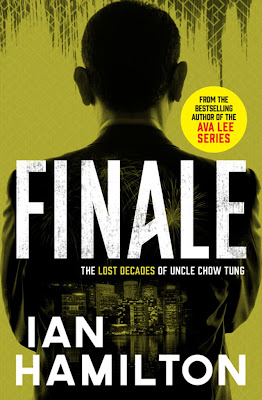
Finale by Ian Hamilton

(19. - 1124.) Finale by Ian Hamilton - Uncle is ailing. It is 2015. The former triad leader and business partner of Ava Lee has been diagnosed with late stage stomach cancer. With his
characteristic fortitude and common sense he decides to undertake chemotherapy. At the same time his modesty and fierce sense of privacy leads him to hide the diagnosis from those who love and care for him.

To do the review I wanted there are spoilers in this post. I do not think they will spoil reading Finale but wanted to provide a warning of their presence.

As set out in the earlier books of The Lost Decades of Uncle Chow Tung he had fled China in 1959 and successfully moved up the ranks of the Fanling Triads to become their Mountain Master. He led Fanling Triads to great success for 30 years. For 10 more years he established and led a council of the combined Hong Kong triad gangs. Then he established his debt recovery business with Ava Lee.

With this book we are reliving events told in books of the Ava Lee series. Uncle’s back story has caught up with the Lee books where his illness was an important part of several plots.

In Finale the story involves the events of The Scottish Banker of Surabaya and The Two Sisters of Borneo from Uncle’s perspective. I found it fascinating seeing Uncle’s actions and reactions while knowing what is to come from reading those books.

The detail in Uncle’s treatment and his bodily and mental reactions are intense. Facing debilitating medical treatments and the probabilty of death tries any soul. Uncle is a brave man who follows the principles of Tao. He does not seek out death but he does not fear dying.

Uncle remains a reserved man. He has deep emotions but they have rarely been revealed in earlier books except with regard to his lost love, Gui-San, who died on their swim to freedom from mainland China to Hong Kong. He cherishes her memory. He never sought another romantic relationship.

Through almost six decades of his life in Hong Kong he has cared deeply for his brother Fanling triads. Rarely was his love for them expressed in words or physical displays of affection.

He has made a personal fortune but always shared generously with his brother triads. He established a reserve fund totalling five years of expenses to meet contingencies.

Uncle showed his absolute loyalty to his brother triads through his actions. If his gang faced trouble he was ready to meet the challenge. When physical confrontations took place he was at the front of his men. When there was an assassination attempt upon him when he was in his early 60’s by three triads of another gang he refused to run but was ready to fight if his bodyguard, Sonny, had been unable to subdue them. His fellow gang members revered him.

Too few leaders in our world are committed to the greater good.

Meeting Ava in his 70’s was an unexpected joy. A protege, both smart and brave, who was imaginative and skilled at physical combat.

In Finale he gradually - reluctantly - gives way on his carefully guarded privacy as his health declines. Approaching death lets him express his love for Ava. He speaks of her as the granddaughter he never had. 

Yet Uncle will not go quietly into the night. In his final days he is as decisive as ever in securing the future of the triads and then using his contacts to save Ava who has been kidnapped.

Hamilton created a character in Uncle who is as compelling as Ava. It takes a great writer to get readers to respect and to care about and to want to read about a little old man. In an era where thriller fiction is dominated by brash, often arrogant, physically outsize figures Hamilton shows how a man of intelligence and strong character can be a hero. Especially now that I am in my senior years Uncle inspires me.

****

Hamilton, Ian - (2012) - The Water Rat of Wanchai; (2013) - The Disciple of Las Vegas; (2014) - The Wild Beasts of Wuhan; (2014) - The Red Pole of Macau; (2016) - The Scottish Banker of Surabaya; (2018) - The Two Sisters of Borneo; (2019) - The King of Shanghai; (2020) - The Princeling of Nanjing; (2020) - Fate; (2020) - Foresight; (2021) - Fortune

Saturday, July 9, 2022

Where Do You Like to Read?

It is a lovely summer evening in Saskatchewan as I sit out on our deck reading and blogging. It is 24C (about 75F). We do not have enough such evenings. On the deck we have comfortable chairs and stools just perfect for reading. While sitting here tonight I have been thinking about where I have liked to read over the years.

When I was a boy growing up on the farm at Meskanaw I usually sat at the end of a heavy set green couch in the house to read a book from the library.

At St. Peter’s College in Muenster where I attended boarding school most of my reading was done at my desk in study hall. We had large desks with angled lift up tops. With study hall 6 mornings a week and 2 more hours 6 nights a week there was lots of opportunity for reading when school work was done.

When I had the chance I would also read downstairs in the school library. I read more magazines there. I read every article in Time magazine every week.

At university in Saskatoon I found I could easily distract myself if I stayed at home so I looked for other spots.

During law school I often studied at the Law Library, many times after it was closed. It was easier to concentrate with fewer people around.

Over the 4 years in Saskatoon I did more studying in the Grosvenor United Church. It was near where I was boarding and rooming. The Church let university students use the classrooms in the Church for studying. Unless it was exam time I was often the only student in the building during the evening. By my third year, if the caretaker knew I was there he would not come to lock up but trusted me to close up the building.

The Church was a good place to study but it could be too quiet. Being in a building alone at night when the pipes creak can be startling especially to those who love mystery fiction.

To avoid distractions I would take only university texts. Still, I would look for something else to read for a break in the evening. Occasionally I would read the Bible. I also read the United Church Observer magazine cover to cover every month.

Once I graduated and moved to Melfort I spent more time at the office my first few years than anywhere else.

After Sharon and I purchased our first house I liked to sit on a couch in our living room reading.

Our current home, where we have been resident for almost 39 years, has a nice office / den. In it are an office chair and a pair of armchairs. For the many months of the year when it was not possible to read outside I read there. I expect I have read 2,000 books in the den.

On nice summer days I love sitting out on the deck under our elm tree. It is a peaceful spot when there are no crows around.

Two years ago I wrote to Michael Christie, author of Greenwood, about the special feeling I have while reading beneath the branches of a great tree. A link to the post of our exchange is below.

While cruising I like to sit in big armchairs in the Horizons lounge at the top of Oceania ships. With the sun shining in, it is a wonderful place for reading.

What I do not attempt on the ship is reading a book while laying face down on a ship lounge chair. Some people manage to read a book held over the front edge of the chair or even placed upon the deck.

If readers of the blog would like to share where they would like to read I would be interested in hearing from you in a comment.

****

Email Exchange with Michael Christie